6 min read
TECHNOLOGY
How to Choose the Right Generative AI Model: A Practical Guide
Written byFelix Agyekum Manu
A guide in choosing the right model
In today's fast-evolving AI landscape, generative models are powering everything from creative writing assistants to stunning image generators and intelligent code copilots. But with hundreds of models available ranging from open-source options like Llama and Stable Diffusion to proprietary powerhouses like GPT-4o, Claude, Grok, and Gemini selecting the right one can feel overwhelming.
The key to success? A structured approach. When selecting a generative AI model, start by clearly defining your specific task or application. Is it text generation for marketing content, image creation for product visuals, code generation for software development, or something more specialized like video synthesis or audio production? Models are highly optimized for particular strengths, so aligning your needs with the model's core capabilities is the foundation of making a smart choice.
Here are the most important factors to consider when evaluating and selecting a generative AI model:
1. Model Types
Generative AI models come in different architectures and specializations. Understanding the main types helps you narrow down options quickly.
- Large Language Models (LLMs): Best for text-based tasks like writing articles, chatting, summarizing documents, or generating code. Examples include GPT series, Claude, Grok (built by xAI), Llama 3, and Mistral.
- Diffusion Models & Image Generators: Specialized in creating high-quality images, art, or visual designs from text prompts. Popular choices include Stable Diffusion, DALL·E, Midjourney, Flux, and Grok's image generation capabilities.
- Multimodal Models: These handle multiple data types simultaneously—text + images, audio, or even video. Great for tasks like describing images, generating visuals from text, or analyzing mixed media.
- Specialized Models: Some are fine-tuned for narrow domains, such as code generation, music/audio, or scientific applications.
Tip: If your task is purely text-heavy, an LLM might suffice. For creative visuals or mixed inputs, lean toward multimodal or dedicated image/video models.
2. Performance Requirements
Performance isn't just about "how smart" the model is it's about how well it meets your real-world needs in terms of speed, quality, and reliability.
- Output Quality: Test for coherence, creativity, accuracy, and consistency.
- Speed & Latency: Real-time applications need low-latency models.
- Scalability & Context Window: Larger context windows (128K–1M+ tokens) are crucial for long documents or complex tasks.
Evaluate performance through benchmarks relevant to your use case.
3. Capabilities
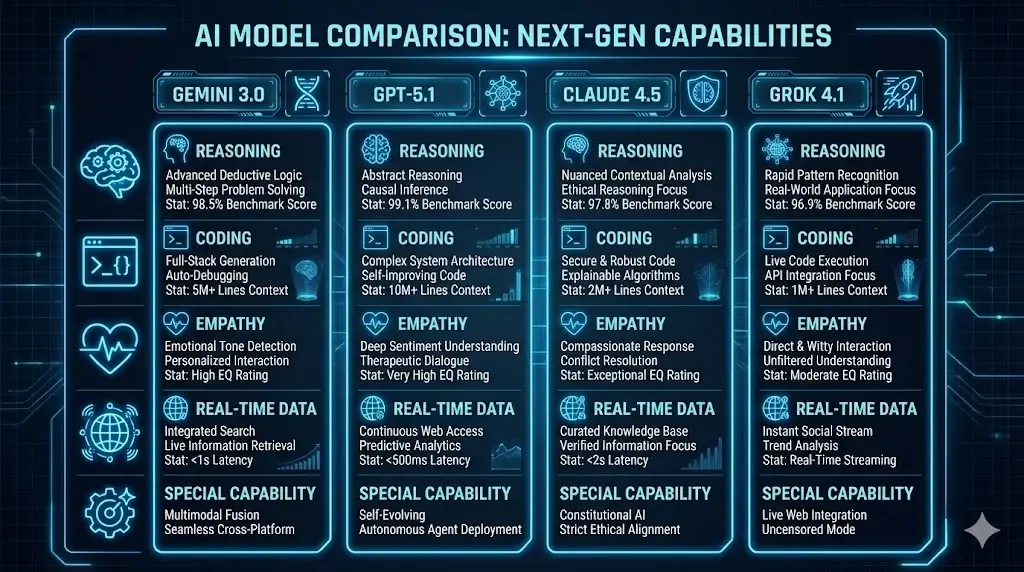
Look beyond basic generation. What unique strengths does the model bring?
- Reasoning & Problem-Solving: Chain-of-thought, tool use, and agentic capabilities.
- Multimodality & Customization: Fine-tuning, RAG, and tool integration.
- Special Features: Real-time knowledge, multilingual support, or safety alignment.
4. Constraints
Every model comes with practical limitations:
- Cost: Pay-per-token, subscriptions, or self-hosting expenses.
- Availability & Hardware: Rate limits, GPU requirements, or deployment options.
- Data Privacy & IP: Check how your inputs and outputs are handled.
5. Compliance
In regulated industries, compliance is non-negotiable:
- Data Privacy & Security: GDPR, HIPAA, etc.
- Ethical & Safety Standards: Guardrails, bias mitigation, and transparency.
- Regulatory & IP Rights: Auditability and commercial usage rights.
Decision-Making Support
Many teams use structured approaches like decision trees or flowcharts to evaluate models based on priorities such as accuracy, speed, cost, or reasoning depth.
Final Tips for Selecting Your Generative AI Model
1. Start Small: Prototype with free tiers or playgrounds.
2. Test Realistically: Use your actual prompts and workflows.
3. Consider the Ecosystem: Integrations, support, and community.
4. Hybrid Approach: Combine multiple models to leverage their strengths.
5. Stay Updated: The field evolves rapidly with new releases and improvements.
Choosing the right generative AI model isn't about picking the "best" overall it's about finding the best fit for your unique needs, constraints, and goals. By systematically evaluating model types, performance, capabilities, constraints, and compliance, you'll save time, reduce costs, and achieve superior results.
© 2026 Felix Agyekum Manu. All rights reserved.